
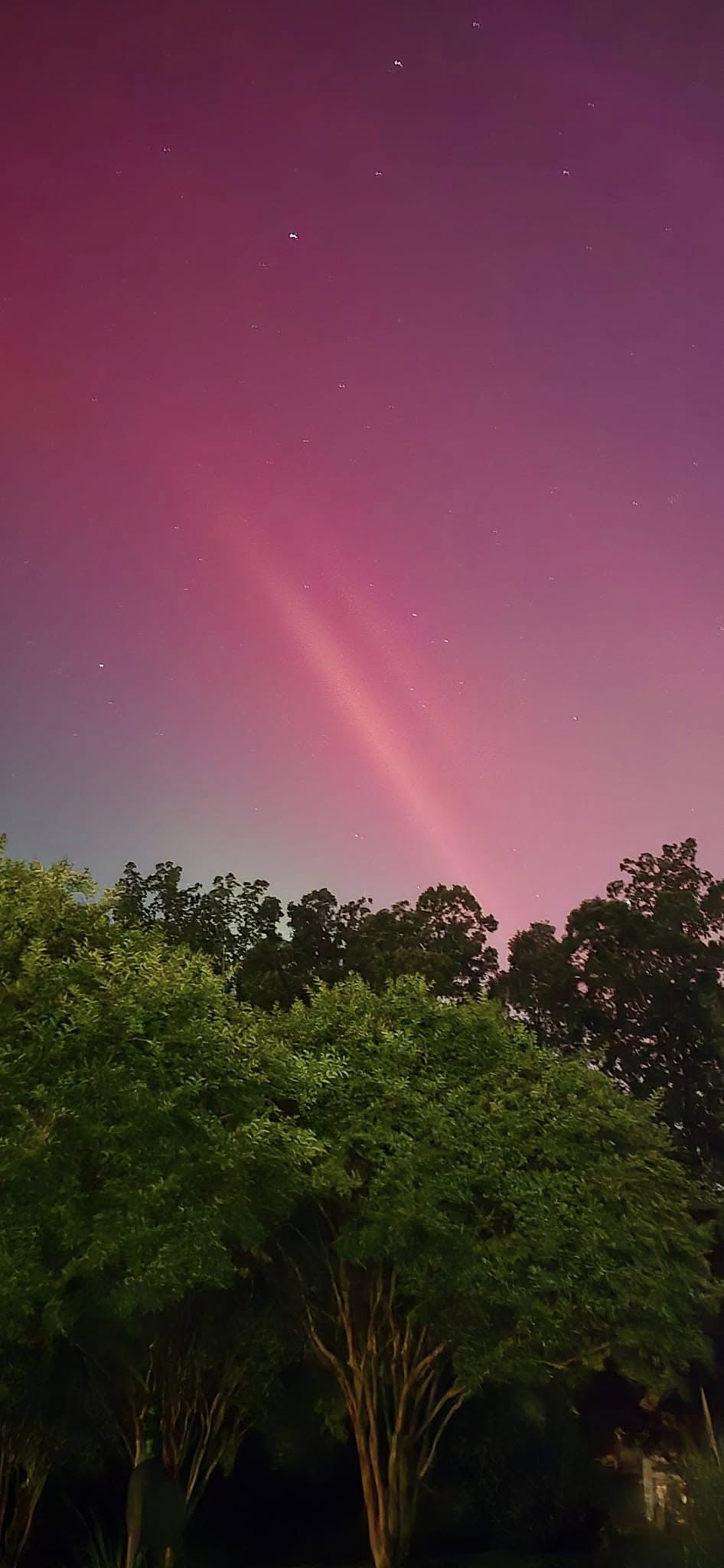
If you have spent any time scrolling social feeds in the past year, you have probably noticed an unusual trend. Friends in Tennessee, the Carolinas, and even North Texas keep posting pictures of purple and green streaks across the sky. These are not cleverly filtered sunsets. They are the aurora. And if it feels like the Northern Lights have been everywhere recently, that is not your imagination.
Let’s break down what the aurora really is, why it happens, and why this particular solar cycle has turned North America into a light show far beyond the usual northern latitudes.
What the Aurora Actually Is
At its core, the aurora is a planetary physics demo that plays out at a massive scale. Charged particles from the Sun stream toward Earth at high speeds. Once they reach our planet, most are deflected by the magnetic field. A small percentage becomes trapped along the magnetic field lines and spirals down toward the poles.
When these energetic particles collide with the gases in our upper atmosphere, they transfer energy to atoms of oxygen and nitrogen. The atoms then release that energy as light. Oxygen gives the classic green glow. Nitrogen contributes purples and reds. Put enough of these collisions together and you get curtains, arcs, and shimmering patches that dance across the night sky.
It is a giant glow stick, only powered by the Sun and stretched across hundreds of miles.
The Role of the Solar Wind
The Sun is not quiet. Even on an average day it sends a steady stream of high-energy particles known as the solar wind. Sometimes the Sun gets rowdier. Large eruptions such as solar flares or coronal mass ejections accelerate far more particles toward Earth in a short period of time.
When these bursts hit Earth’s magnetic field, the system gets overloaded, and the aurora becomes more intense and more widespread. Instead of staying pinned to the far north, the glow expands to latitudes that rarely see it.
That is why a normally calm location like North Carolina can suddenly light up like a long-exposure photo from Anchorage.
The Solar Cycle
The Sun operates on an eleven-year cycle of magnetic activity. At the low point, solar activity is minimal. At the high point, known as Solar Maximum, the Sun produces more sunspots, more eruptions, and more opportunities for energetic particles to reach Earth.
Not all solar maxima are equal. Some are modest. Others are powerful. The current cycle, Solar Cycle 25, has surprised almost everyone. Early predictions suggested a fairly average peak. Instead, it has ramped up faster than expected and is showing signs of being one of the strongest cycles in decades.
A strong solar maximum means more geomagnetic storms. More storms mean more auroral activity. And that means a light show for people far south of the usual viewing zone.
Why We Are Seeing Auroras So Far South
Several factors have lined up at once.
1. A Stronger Solar Maximum
The Sun is simply more active than expected. It is generating more frequent and more energetic eruptions.
2. Multiple Eruptions in Close Succession
When several coronal mass ejections collide with Earth one after another, the magnetic field becomes compressed and stressed. This produces stronger and more expansive auroras.
3. A Magnetosphere Under Pressure
When solar plasma clouds hit Earth head-on, the magnetic field lines get pushed and stretched. This causes auroral ovals to widen significantly. People in regions that rarely see auroras suddenly find themselves under the glow.
4. Better Reporting
Smartphones and social media let millions of people capture and share the lights instantly. Stories that once lived only in northern communities now go viral in minutes. It creates the sense that auroras are new. They are not new. But they are definitely more frequent right now. My own current phone, a Samsung Galaxy S24 Ultra, has some pretty powerful light amplification and AI features for my pics that have been unavailable on any other phone I’ve owned. That’s how I captured the photo above from the Charlotte, NC area.
What This Means Going Forward
We are at the front edge of the peak of Solar Cycle 25. The activity will likely remain elevated for at least another year and possibly longer. That means continued opportunities for auroras at mid-latitudes.
It also means a higher likelihood of short-lived disruptions to radio communications, GPS accuracy, and even power grid stability. None of this is cause for panic, but it is a reminder that we live next to a star. That star goes through seasons, and we are moving through one of its liveliest.
For sky watchers, photographers, and anyone who appreciates the rare feeling of seeing the sky come alive, this is a special moment. It is not often that so much of North America gets a front-row seat to one of nature’s most spectacular shows.
So if you have clear skies, low light pollution, and a compass that points vaguely north, it may be worth stepping outside on the next active night. The Sun is doing its part. The rest is just timing.
Let me know what you think, and post your own pics in the comments!
Leave a Reply