
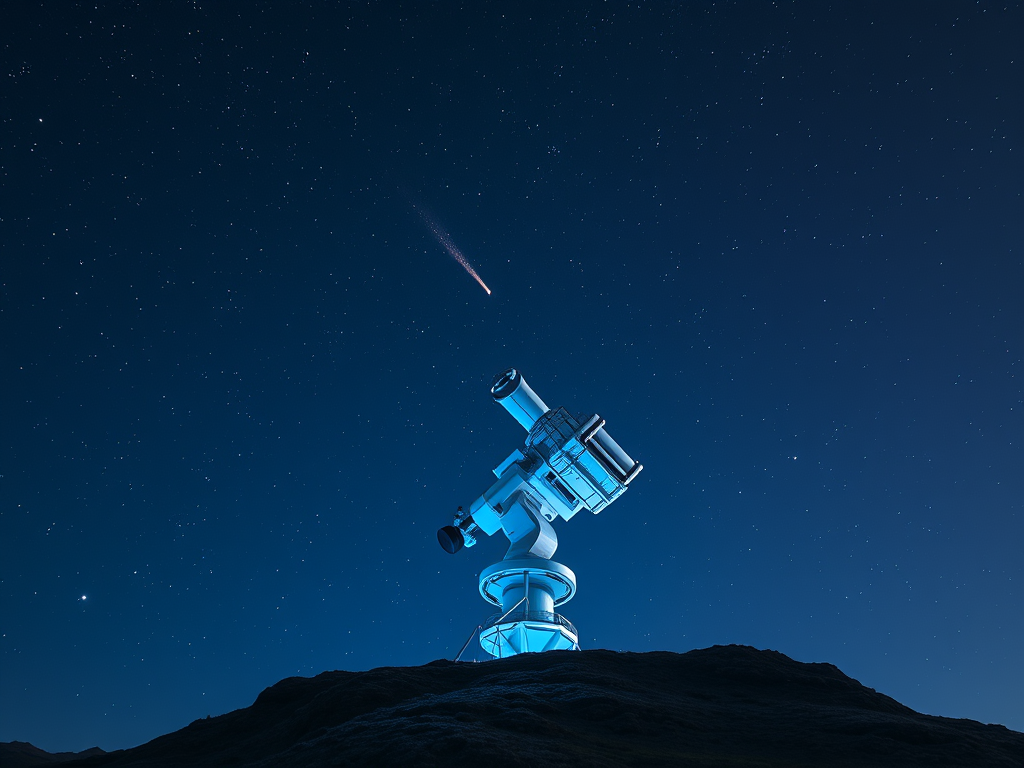
Spoiler: It’s not a coincidence. It’s a set of telescopes keeping an eye out for trouble.
The Curious Case of the “ATLAS” Comets
If you have ever seen headlines like “Comet ATLAS Brightens in the Evening Sky” or “Astronomers Discover Interstellar Comet 3I/ATLAS”, you might have wondered why so many comets seem to belong to something called “ATLAS.”
It turns out there is no mythological titan involved. The name comes from a network of telescopes called the Asteroid Terrestrial-impact Last Alert System, or ATLAS for short.
ATLAS is designed to scan the entire sky each night and spot anything that moves in ways that might be dangerous, interesting, or both. When one of its telescopes discovers a new object, that discovery is recorded in the official name. So when you see a comet like C/2020 M3 (ATLAS), the “ATLAS” part simply means it was first spotted by that system.
A Last-Minute Warning System for Space Rocks
ATLAS was created for a specific mission: to find asteroids that are heading toward Earth with only days or weeks of warning. Most large asteroids are already being tracked years in advance by other surveys, but smaller ones can sneak up quickly. Many are invisible until they are close to Earth.
Rather than competing with deeper, slower surveys, ATLAS fills the gap. It trades detail for speed and coverage. Its job is to make sure that if a smaller asteroid is on an inbound path, we still have some notice before it arrives.
ATLAS is part of NASA’s Planetary Defense program. In addition to spotting potential impactors, it often finds supernovae, variable stars, and comets that happen to flare up in its nightly watch.
The System Behind the Name
ATLAS is not one telescope sitting on a mountain. It is a global network of small, wide-field robotic observatories. The first two were built in Hawaiʻi on Haleakalā and Mauna Loa. Two more later came online in South Africa and Chile, giving the system nearly full-sky coverage. A fifth telescope in Spain was added in 2025 to fill remaining gaps.
Each telescope uses a mirror only half a meter across, but it can see an enormous portion of the sky. Its field of view is about seven degrees wide, which is roughly fourteen times the width of the full moon. The telescopes are designed to take quick, wide snapshots of the sky rather than long, deep exposures.
This approach makes perfect sense. Asteroids move. You do not need extreme detail; you need to cover the sky quickly and catch changes from one image to the next.
How ATLAS Spots New Objects
Each night, ATLAS follows a predictable rhythm.
- It scans a section of the sky four times per night, with about fifteen minutes between exposures.
- It looks for changes in position or brightness.
- Its software compares images, identifies which points of light have moved, and calculates a preliminary orbit.
- If the moving object does not match a known asteroid, an alert goes out to the Minor Planet Center for confirmation and follow-up.
Most of what it finds are harmless main-belt asteroids. But every so often, something new appears. That could be a previously unseen near-Earth asteroid, a long-period comet, or even, as in 2025, an interstellar object.
That is why comet names often include “ATLAS.” Each one began as a faint, moving dot in one of these automated sky sweeps.
How Much Warning Does It Really Give?
The warning time depends on how big and how bright the object is.
- A 100-meter asteroid might be visible for several weeks before a close pass.
- A 10-meter object, similar in size to the Chelyabinsk meteor, might only be detected a few days before arrival.
- For very small, fast objects, ATLAS might spot them only a day ahead.
That may not sound like much, but it can be enough time to issue alerts or move people away from an expected impact zone. The entire system is built around one trade-off: it gives up faint sensitivity in exchange for rapid, repeated coverage of the whole sky. In other words, it patrols every street in the cosmic neighborhood instead of staring deeply into one alley.
Why “ATLAS” Keeps Appearing in Comet Names
Because ATLAS runs every clear night, it ends up discovering far more than asteroids. Its wide-field cameras also catch supernovae, variable stars, and of course, comets.
Whenever a new comet is officially confirmed, it is named for whoever discovered it. That is why you see names like C/2019 Y4 (ATLAS) or C/2020 M3 (ATLAS). The “ATLAS” tag simply means that one of the ATLAS telescopes was the first to spot it.
The discovery of Comet 3I/ATLAS in 2025 was especially exciting because it turned out to be only the third interstellar object ever detected, meaning it came from outside our solar system. Not bad for a project originally built as an asteroid alarm.
Strengths, Challenges, and Trade-Offs
ATLAS works so well because it accepts its limitations.
Strengths
- Global coverage that allows nearly the entire sky to be scanned every 24 hours
- High repetition rate, which makes it excellent at catching moving objects
- Low cost compared to large observatories
- Automatic data processing and near real-time alerts
- Complements deeper surveys rather than replacing them
Challenges
- It cannot detect very faint, distant objects early on
- It has difficulty spotting objects coming from near the Sun’s direction
- Weather or technical problems can interrupt coverage
- Occasionally false positives occur from satellites or camera noise
- For very small asteroids, even detection might come only hours before arrival
Despite these limits, ATLAS fills a crucial niche that no other system covers as efficiently.
The Unsung Hero of Planetary Defense
ATLAS does not take pretty pictures. Its data are functional, not artistic. But night after night, its telescopes quietly sweep the heavens, watching for change.
Since 2015, it has discovered hundreds of near-Earth objects, dozens of comets, and even a few surprises from interstellar space. Each discovery makes our catalog of small bodies a little more complete and our warning system a little stronger.
It is not glamorous work, but it might be some of the most practical science being done anywhere on Earth.
Why It Matters
The odds of a large asteroid impact are low, but smaller impacts happen on human timescales. Having even a few days of warning can mean the difference between surprise and preparation.
That is the power of ATLAS. It gives us eyes on the sky that never tire and never blink. It helps scientists track what is coming and alerts humanity before danger arrives.
So next time you hear about a new Comet ATLAS glowing in the night sky, you will know what that name really means. It is not a mythic god holding up the heavens. It is a tireless set of telescopes quietly scanning the stars, giving us a little more time to look up before something unexpected looks back.
Leave a Reply